
Most under-eye darkness isn't a stain you can scrub away. In published case series the majority has a blood-vessel component, which is exactly the part a jar of serum struggles to shift.
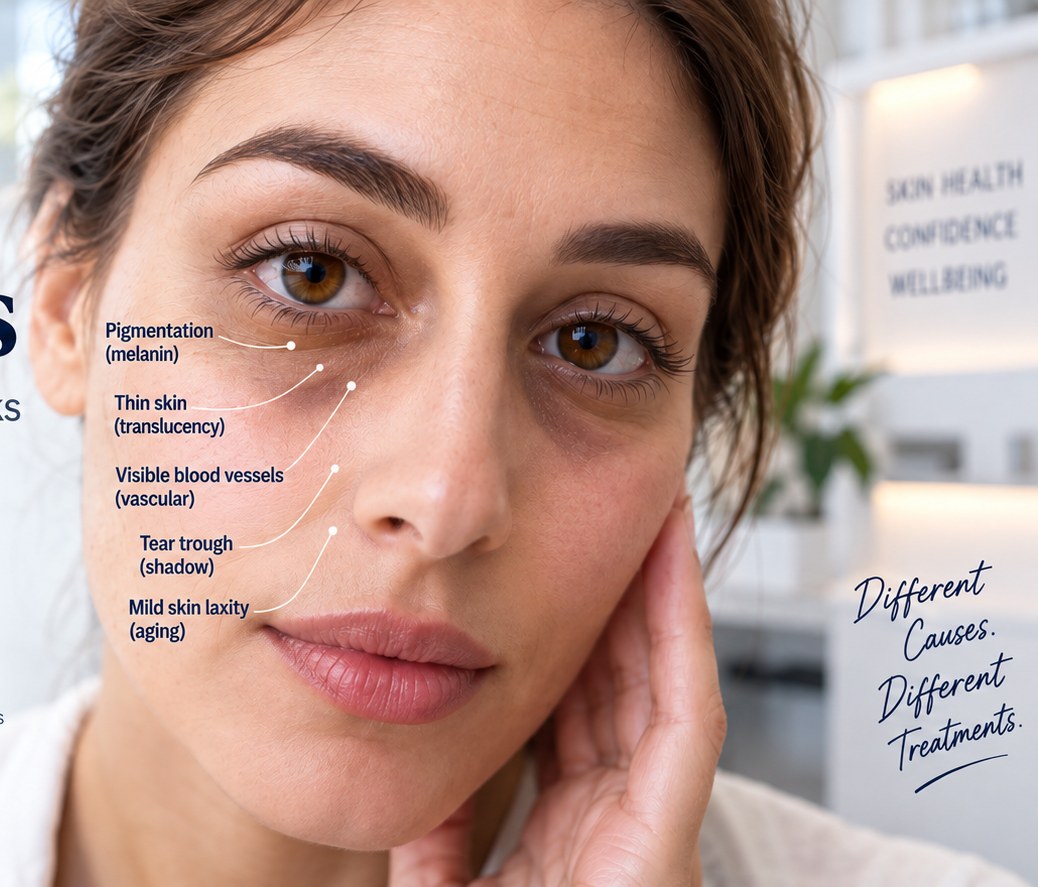
Illustrative image. The labels show the anatomical contributors discussed below. Not a patient of this practice, and not a treatment result.
Dark circles under eyes are caused by four different things, often at once: blood vessels showing through thin lower-eyelid skin, extra pigment in the skin, shadows cast by the tear trough and eyelid laxity, and puffiness. The vascular component is the most common one.
That matters because treatment only works when it's matched to the cause. Pigment responds to topicals and peels. Vessels and shadows generally don't. If your darkness is new, one-sided, or comes with fatigue or allergy symptoms, it's worth a GP review before you spend money on creams.
This article is general health information only. It is not medical advice, a diagnosis, or a treatment recommendation for any person(s). Under-eye darkness has many causes and some of them need examination to tell apart. Please consult your GP about your own situation.
Every figure below is taken directly from the cited study. Where a number is a sum of two reported subgroups, we've shown the arithmetic rather than claiming a single reported figure.
A systematic review of 50 studies grouped the underlying problem into volume loss, pigmentary change, vascular prominence and skin laxity.
Blood in the vessels beneath thin lid skin.
Genuine brown pigmentation, often related to skin type.
The tear trough and lid laxity cast a shadow.
Thinner dermis lets underlying colour show through.
Fat and fluid make a shadow below the bulge.
The phrase is a public label, not a clinical one. Researchers sort periorbital darkening into vascular, pigmented, structural and mixed types, and the type decides what helps.
There's a simple pointer described in the literature. Vascular-type darkness tends to look blue or purple and gets worse when the area is stretched. Brown pigment doesn't behave that way: it's a steady colour that stays put when you pull the skin.
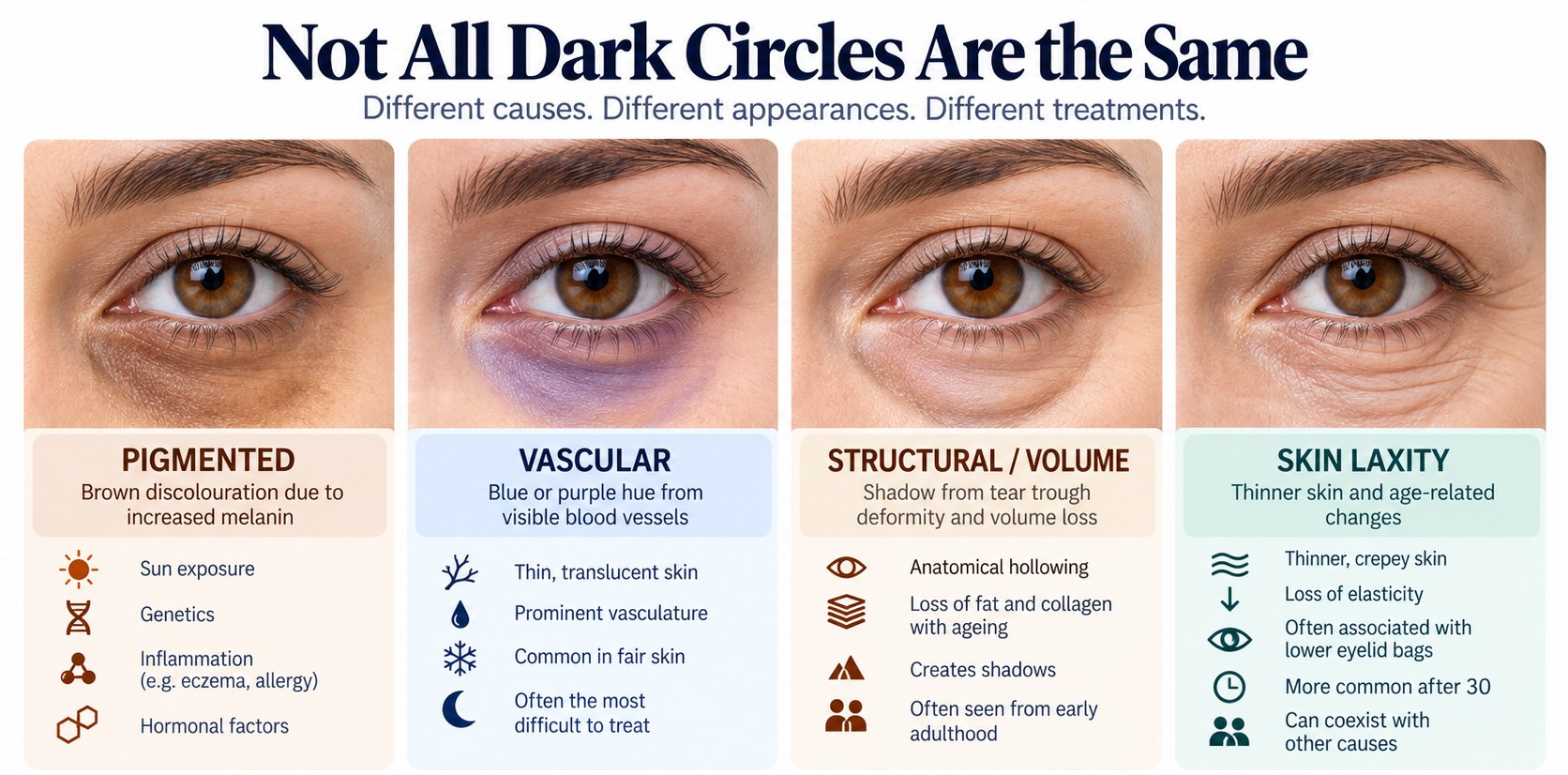
An Australian-led assessment framework published in 2026 sets out how clinicians tell these apart in the room, and the method is mostly about lighting. Bright light with the lower eyelid skin stretched accentuates true pigmentation. Overhead or dimmed light accentuates structural shadowing.
Why this is the whole article in one idea: if you don't know which type you have, you're buying treatment at random. Many products marketed for dark circles target pigment, and pigment alone accounts for a small minority of cases.
In a Korean series of 100 patients, the two commonest presentations were vascular type at 58% and mixed type at 34%. Add those and 89% of that group had a vascular element contributing to the darkness. A separate Malaysian series of 50 found vascular was the most common single subtype at 51%, with purely pigmented a minority.
Different populations, different exact percentages, same direction. The blue-grey component is the norm and pure brown is the exception. Worth saying plainly: these are hospital and clinic series from Asian populations, so the proportions won't transfer perfectly to every patient in Perth. The pattern is consistent enough to change how you think about the problem.
A 2020 multispecialty systematic review of 50 studies framed the problem as structural volume loss, pigmentary change, vascular prominence and skin laxity acting together. Ageing pushes on more than one of those at the same time. As the lower lid loses support and the fat pads shift, the tear trough deepens and the shadow gets longer. Meanwhile sun exposure adds pigment on top of whatever vascular darkness was already there.
Dermal thickness is the quiet variable. Japanese researchers reported that the thickness of lower-eyelid skin is itself a factor in how dark circles appear. Thinner skin is a rare measure of underlying blood looks worse on some faces than others.
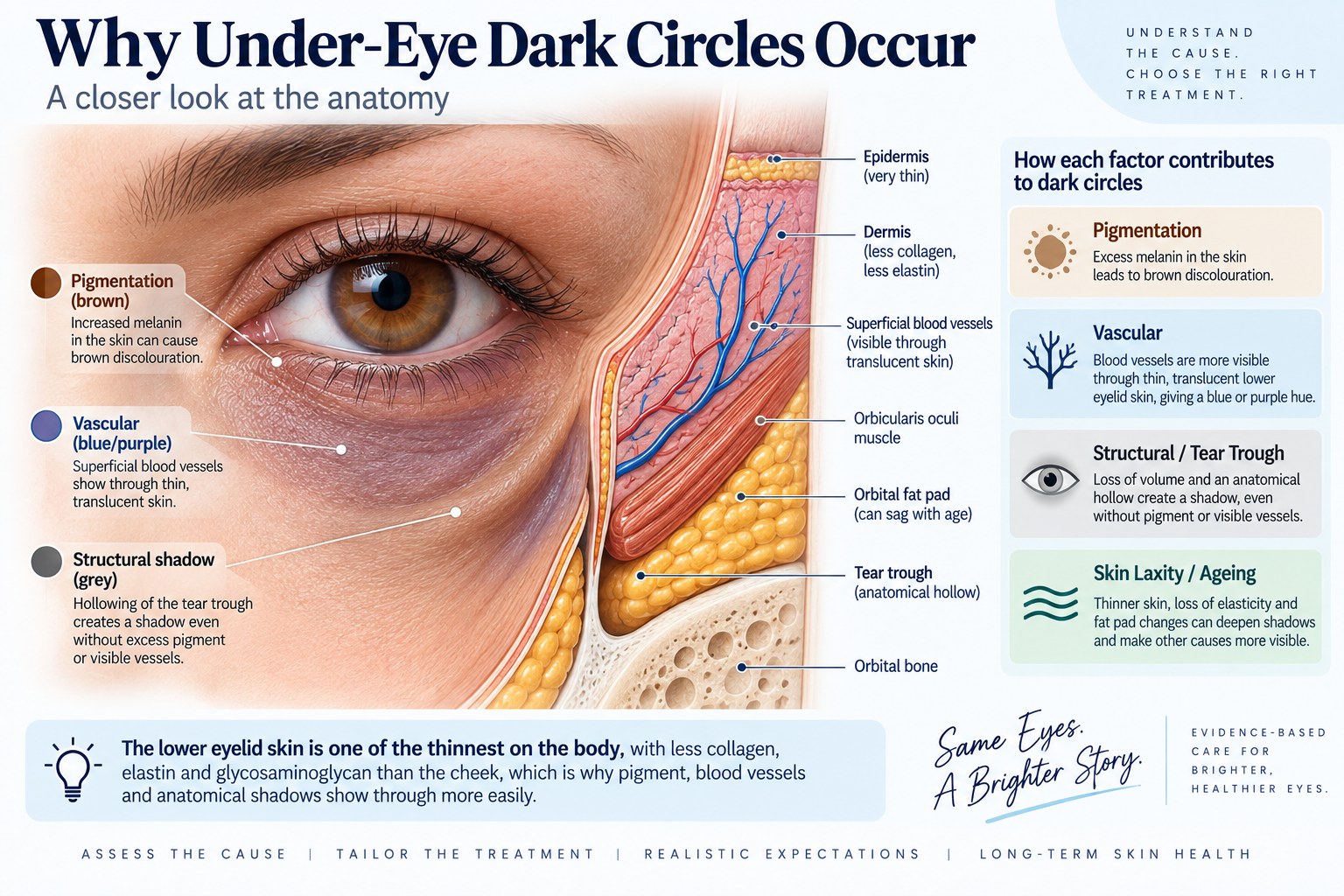
Why the layers matter. Instrumental studies of the infraorbital region identify three key contributors to dark circles: skin thickness, the number and calibre of under-eye capillaries, and pigment deposition. Lower eyelid skin is extremely thin, which is why small changes in any layer are visible.
Practical consequence: a mixed picture is the most likely thing you have, particularly past your thirties. Mixed pictures need more than one lever, and some of those levers sit outside a skincare routine.
This is where a GP visit genuinely adds something a cosmetic counter can't. Case series looking at what sits alongside periorbital darkening have turned up a consistent list of correctable contributors.
In 36 patients with periorbital hyperpigmentation, an eye-related problem was found in 40%: frequent cosmetic use in 38 (51%) patients, nasal congestion and an uncorrected refractive error such as myopia in 35%. Atopy was present in 33% and a family history in 63%.
A smaller study of 60 patients ran bloods and found anaemia in 13.33%, subclinical hypothyroidism in 6.66% and low vitamin D in 10%, alongside atopy in 36% and seasonal allergies in 28.33%. The authors' conclusion was simply that correctable factors should be addressed. There's no evidence that dark circles are caused by low iron. But if you're also tired, breathless on the stairs, or having heavy periods, blood tests are a reasonable next step.
Allergy deserves a specific mention. Persistent nasal congestion and rubbing are a recognised route to post-inflammatory pigmentation around the eyes, and treating the rhinitis addresses the cause rather than the colour.
Reasons to book a review rather than shop: darkness that's new or changing, one side only, swelling that comes and goes, or any accompanying symptom such as fatigue, breathlessness, persistent congestion or unexplained weight change.
Topicals aren't useless. A 10-year review of the literature up to December 2023 found statistically significant results across a long list of ingredients, including caffeine, growth factors, bark extracts and retinoids. The authors were also blunt about the limits: few trials were large randomised controlled studies and lacked long-term follow-up, so strong evidence-based recommendations still aren't possible.
Two individual trials show why expectations need managing. In a six-month split-face study of 14 people, 10% vitamin C lotion reduced the erythema index and increased dermal thickness compared with vehicle alone, with the lightening attributed to thicker skin concealing the darkness beneath rather than bleaching anything. In a separate eight-week open-label study of 57 volunteers, a gel combining 2% phytonadione, 0.1% retinol and 0.1% each of vitamin C reduced haemoglobin in 47% of patients, but pigmentation was not clearly removed.
Notice those two results point in different directions. One worked on the vascular reading, the other didn't affect pigment. That inconsistency is the honest state of the evidence, and it's precisely what the 10-year review described.
What this means for your shopping: six months is a realistic timeframe for a topical trial, not six days. Most products remove a blue-grey shadow, because a shadow is geometry rather than colour. Be sceptical of any claim that a single ingredient fixes all dark circles.
Some causes sit outside what a topical or a GP consultation can address, and the published reviews are consistent about which is which. A systematic review of 38 studies concluded that soft-tissue fillers and autologous fat grafting were most effective where volume loss was the driver, that laser treatments gave modest benefit for pigmentation, and that peels and lasers suit pigmentation and dermal thickening differently. A 2026 review reached the same anatomy-driven conclusion.
Both reviews carry the same caveat and it's an important one. The authors of the 39-study review noted that high-quality evidence was scarce and recommendations should be interpreted cautiously. These are specialist dermatology and surgical procedures, they carry their own risks, and they're described here so you understand how clinicians categorise the problem. They are not offered at Iluka Medical Centre and nothing here is a recommendation that you have any of them.
Sequence that makes sense: clarify the cause, correct anything medical or behavioural that's contributing, give a reasonable topical trial time to work. If a specialist opinion is worth seeking, you'll then have an informed conversation.
Under-eye darkness is usually a mix, and the largest ingredient in that mix is blood vessels seen through thin skin. The component least likely to respond to a cream is the one most likely to be doing the work.
The evidence for topicals is real but modest and inconsistent, built mostly on small short trials. The evidence for procedures is better organised by cause than by product, and still limited by study quality. Neither is a shortcut.
Which is why the useful first step isn't a purchase. It's working out which type you have and whether something correctable, like allergy, thyroid function, sleep or an uncorrected glasses prescription, is adding to it.
Every figure quoted in this article was checked against its published source. Where a study reports only subgroup counts, the combined figure is our own arithmetic and is labelled as such. Replace the placeholder reference list above with your final citations.