
What Is a Spirometry Test? Complete Guide for Patients
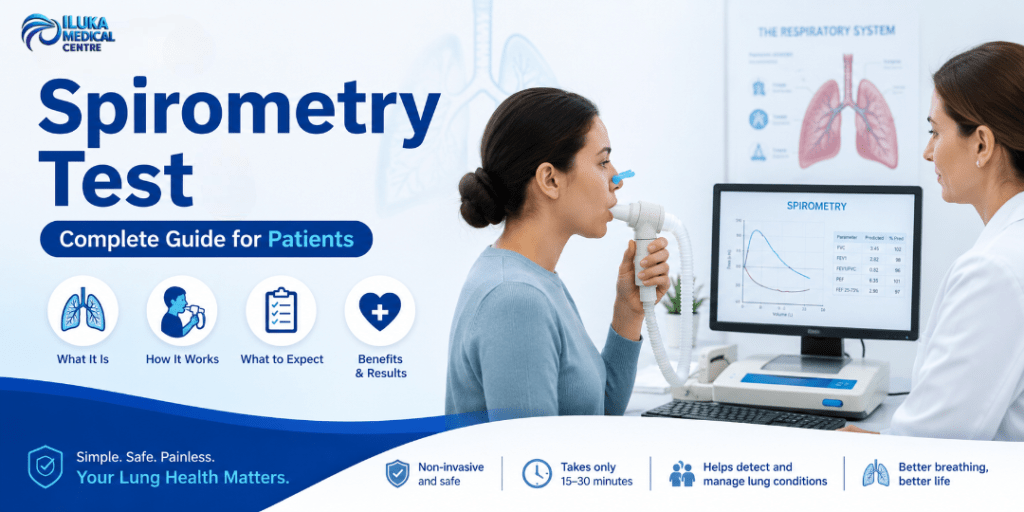
If your GP has recommended that you have a spirometry test, you may be asking what this includes and why it is necessary. The spirometry test (pronounced spy-ROM-uh-tree) is a frequent and safe lung function test, often called a pulmonary function test (PFT). In simple terms, this test analyses how well your lungs perform. It measures how much air you can breathe in and out and how fast you can blow it out.
Short of breath, hacking cough or wheezing? A spirometry test can give your doctor a fair indication of how well your lungs are working. Your GP will also be able to assist in creating an accurate diagnosis, diagnose ongoing illnesses and plan successful treatment by evaluating your lung function.
Why Do Healthcare Providers Order a Spirometry Test?
Your healthcare physician may offer a spirometry test for a number of reasons, mostly related to your breathing and lung health. Your GP may recommend it if you have any of the following:
Asthma Diagnosis and Other Respiratory Conditions
If you or your kid is having problems breathing, wheezing or has a persistent cough, a spirometry test can be used to diagnose illnesses such as asthma, COPD (Chronic Obstructive Pulmonary Disease), chronic bronchitis and pulmonary fibrosis. This information will help your GP to assess what will be the best therapy for you.
Pre-Surgery Lung Check
Your lungs have to be in good health before you have major surgery. A lung function test can examine your respiratory fitness and reduce any issues before or after the procedure.
Workplace Screening
Major surgery may only be performed if your lungs are in excellent shape. Your GP may offer you a spirometry test as part of routine screening to verify that your lungs are coping with these environmental impacts.
Monitoring Chronic Conditions
If you have a lung issue, your GP may give you a spirometry test to check on your condition over time and update your treatment options.
In each of these scenarios, the test offers a quick, non-invasive method to learn about your lung health and help guide appropriate management.
How the Test Works: Step-by-Step Procedure
A spirometry test is easy, quick and typically not painful. Here’s what you’ll get:
1: Prepare
We’d like you to be sitting comfortably. Your nose will be pinched shut so that all the air goes through the mouthpiece. This will ensure accurate readings.
2: Breathe in and out
You’ll take a deep inhale and then blow out as hard and as fast as you can into the device. Don’t worry, the exam is safe, and the specialists will help you every step of the way.
3: Lather, Rinse, Repeat
You’ll perform this technique at least 3 times to get solid results. Your GP will look at the readings to make sure they are consistent.
4: Test For Bronchodilator
In certain cases, your GP may recommend a medication like Ventolin to help expand your airways. Repeat the test about 15 minutes later to assess if your lung function has improved. This can be beneficial in detecting disorders such as asthma.
How Long Does a Lung Function Test Take?
It’s simpler to prepare for your appointment when you know when your lung function test is planned. Depends what test your GP sends you for. How long is it?
| Type of Test | What It Measures | Average Time |
| Basic Spirometry | Airflow and basic lung capacity | 15–30 minutes |
| Complete PFT | Lung volumes, airflow, and gas exchange (DLCO) | 45–90 minutes |
| Cardiopulmonary Exercise Test (CPET) | Lung and heart performance during exercise | Around 90 minutes |
Your general practitioner (GP) will identify the suitable test after considering your symptoms, medical history and concerns about breathing. At Iluka Medical Centre, we explain your results clearly so you understand exactly what is going on with your lungs without the complexity of medical terminology.
Patient Preparation Tips: How to Get Ready
Proper preparation helps ensure accurate results. Here are some tips to follow before your spirometry test:
Inhalers and Medications
Take or pause your puffers and breathing medications only as instructed by your GP. This ensures your test results are not affected.
Smoking and Vaping
Avoid smoking or vaping for at least six hours before your test. Smoke can temporarily affect your lung function and give inaccurate results.
Diet and Exercise
Avoid heavy meals, caffeine, and strenuous exercise a few hours before the test. This can make breathing easier and improve the accuracy of the test.
Clothing
Wear loose, comfortable clothing so you can breathe deeply without restrictions.
Following these steps helps you get the most accurate and reliable results.
Understanding Your Spirometry Results: FVC, FEV1, and Z-Score
After the test, your GP will explain your results in simple terms:
- Forced vital capacity, or FVC, is the maximum volume of air that a person can exhale abruptly after inhaling deeply.
- FEV1 (Forced Expiratory Volume in 1 second): How much air you can blow out in one second.
- The results are compared to the normal ranges for your gender, age, and height. Usually, results higher than 80% are obtained.
- You may see how your lung function stacks up against healthy averages using the Z-Score.
- Differentiate between airway obstruction (as in asthma and chronic obstructive pulmonary disease) and problems with lung expansion (as in restrictive patterns).
Your GP at Iluka Medical Centre can break down what these numbers mean for your health and guide the next steps in your care.
Risks and What to Expect After the Test
A spirometry test is very safe, but you may experience mild side effects:
- Possible short-lived side effects include dizziness, coughing, or mild exhaustion following deep breathing; however, these symptoms often subside within a short while.
- Concerning the test’s safety, please let your doctor know in advance if you’ve ever had a stroke, heart attack, or eye operation.
- You can immediately return to your routine activities and medicines after the exam.
Your GP will ensure the test is done safely and comfortably, answering any questions you may have.
Tips For Talking to Your GP About a Spirometry Test
When arranging your Iluka Medical Centre consultation, it is helpful to be armed with information about your symptoms and history:
- When did your breathing problems start? How often do they happen?
- Document a family history of asthma, COPD or other lung problems.
- Details about your current inhalers and medications.
- Report any recent exposures to environmental dangers at work or home.
Provided with this data, your primary care physician will be better able to advise you on the necessity of a spirometry test and other diagnostic procedures.
Conclusion
A spirometry test is a simple, safe, and effective way to understand your lung health. By measuring your lung function, your GP can identify conditions like asthma, COPD, and other respiratory issues early, giving you the best chance of effective management.
Don’t dismiss shortness of breath, a lingering cough, wheezing or chest discomfort. The first step to improving your breathing and your general health is to get an accurate diagnosis.
Contact Iluka Medical Centre to make an appointment if you reside in Iluka or the surrounding areas of northern Perth. Our friendly GPs will look at your symptoms and check that your lungs are healthy. Getting it early is important for your lungs, so don’t wait.
FAQs
What is a good score on a spirometry test?
A good result on a spirometry test is often 80% or higher of the anticipated value. Your GP will review the findings of your lung function tests and compare them with normal ranges at your Iluka Medical Centre consultation.
What are the signs of poor lung function?
Poor lung function can cause shortness of breath, wheezing and a long-term cough. To look for problems related to an asthma diagnosis, your GP may do a lung function test or PFT.
What diseases are diagnosed by PFT?
PFT can diagnose asthma, COPD and other lung diseases. “Your GP at Iluka Medical Centre will typically carry out a spirometry test to confirm a diagnosis of asthma.
What is the 4-4-4 rule for asthma?
The 4-4-4 guideline is 4 puffs, wait 4 minutes, and repeat 4 times if needed. Even still, a spirometry test and lung function test are required for a correct asthma diagnosis from your GP.
What happens if your lung function is low?
Low scores on a lung function test might indicate respiratory difficulties like asthma or COPD. At your consultation with Iluka Medical Centre, your GP will discuss the findings of your spirometry test and advise on therapy.
What is the difference between a doctor and a GP?
Your first stop for a spirometry test or PFT is a GP. At your consultation at the Iluka Medical Centre, your GP will take care of your daily health and breathing.