
of Australians self-reported hay fever in 2022, about 6.1 million people[1]
Up from 16% in 2001 (+8 points)People aged 15 and over compared with children aged 0 to 14[1]
Adults report it about twice as oftenHow long a cold usually takes to settle. Hay fever lasts as long as the exposure does.[11][8]
A useful clueUsual length of allergen immunotherapy for severe hay fever.[8]
Long-term optionHay fever is one of the most common chronic conditions in Australia. In the 2022 National Health Survey, 24% of people said they had it, up from 16% in 2001.[1] Those figures are self-reported, so researchers point out they may differ from clinically confirmed rates.[2]
In Perth the pollen load tends to shift during spring rather than arrive all at once. Tree pollen, including cypress, usually opens the season from around August.[3] Cypress pollen allergy is well described as a late winter to early spring problem in Mediterranean-type climates like Perth's.[4] On 14 September 2026, cypress was the main pollen in Perth's forecast and grass pollen hadn't started yet.[3]
Grass pollen follows. Local monitoring in Perth runs from 1 October to 31 December, with levels expected to build through November.[5] Grass pollen is a major trigger for both hay fever and asthma in Australia.[7] If you react to both trees and grasses, the handover from one to the other can make spring feel like one long season.
Approximate timing only, based on local forecast and monitoring information.[3][5] Darker shading shows the busier part of each season.
People with pollen allergy often notice their symptoms improve in wet weather and get worse on hot, windy days.[8]
The bigger picture is a bit counterintuitive. A systematic review of 93 studies found warmer temperatures were linked with earlier, longer pollen seasons and higher pollen concentrations. Over the longer term, more rainfall was linked with higher grass pollen levels.[9] So a wet winter can set up a stronger grass season, even though a rainy afternoon brings short-lived relief. Perth's 2025 grass season outlook made the same point about wetter soils and greener vegetation.[5]
Typical symptoms include sneezing, an itchy runny nose, itchy watery eyes, an itchy throat and a blocked nose, which can lead to mouth breathing and snoring.[8] When symptoms are severe they can disturb sleep and cause daytime tiredness, headaches and poor concentration.[8]
Hay fever often travels with other conditions. It's associated with asthma, eczema and chronic or recurrent sinusitis.[10] For people who already have asthma, poorly managed hay fever is linked with more asthma symptoms.[8]
Common symptoms and linked conditions. Illustration for general education.
A cold usually gets better on its own within 7 to 10 days. It can sometimes cause a low-grade fever, which is more common in children than adults.[11] Hay fever doesn't cause a fever, and its symptoms tend to continue for as long as the exposure does.[8]
| Feature | Hay fever | Common cold |
|---|---|---|
| Cause | Allergic reaction to triggers such as pollen, dust mite, moulds or animal dander[8] | Virus, most often rhinoviruses or coronaviruses[11] |
| Fever | No[8] | Sometimes low-grade more common in children[11] |
| How long it lasts | As long as the exposure continues, unless treated[8] | Usually 7 to 10 days[11] |
| Spreads to others | No | Yes, highly contagious[11] |
Hay fever compared with a cold. Illustration for general education.
Avoiding the trigger is part of standard advice.[10] Practical steps people use in spring include checking the daily pollen forecast, keeping windows closed on high pollen days, showering and changing clothes after time outdoors, and drying washing indoors during heavy pollen weeks.

Everyday ways to cut down pollen exposure at home. Illustration for general education.
Medicines don't cure hay fever, but used correctly they can control symptoms well and often have few side effects.[8] Many are available from pharmacies and some need a prescription, so a pharmacist or GP can help you choose.[12][13]
| Option | Examples | Good to know |
|---|---|---|
| Non-sedating antihistamine tablets | Cetirizine, fexofenadine, desloratadine, loratadine[10] | Mild symptoms Help sneezing and itchy eyes, less effective for a blocked or runny nose. Can be taken only when needed.[8][10] |
| Antihistamine nasal sprays | Azelastine, olopatadine[10] | Mild symptoms Another first-line choice for mild hay fever.[10] |
| Corticosteroid nasal sprays | Fluticasone, budesonide, mometasone, triamcinolone[10] | Persistent or moderate to severe The usual first treatment. Work best used every day, like an asthma preventer. Benefit can take days to start, and technique matters.[10][8][12] |
| Combined steroid and antihistamine spray | Single spray with both medicines | Persistent symptoms Offers the benefits of both medicines together.[8][10] |
| Decongestant sprays | Short-term nasal decongestants | Caution Only for a few days at a time. Longer use can make congestion worse.[8] |

Common medicine types for hay fever. Generic illustration only, not a recommendation of any product or dose.
It's worth booking in if any of these apply to you:
Allergy testing can identify the specific trigger behind your symptoms, and once that's known, treatment options can be discussed. People whose symptoms affect day-to-day function may need a referral to a clinical immunology or allergy specialist for testing.[8]
Allergen immunotherapy, also called desensitisation, involves regular, gradually increasing doses of the allergen. It's given as injections, or as tablets, sprays or drops under the tongue. It can reduce symptom severity and the need for regular medicines. Treatment usually runs for three to five years for severe hay fever and should be started by a specialist.[8] It's often considered when medicines don't help or cause side effects, or when the trigger is hard to avoid, such as grass pollen.[15]
What sets immunotherapy apart is how long the effect can last. Large placebo-controlled trials that followed people after treatment stopped have shown long-term benefit, and guidelines recommend continuing for at least three years to get there.[14]
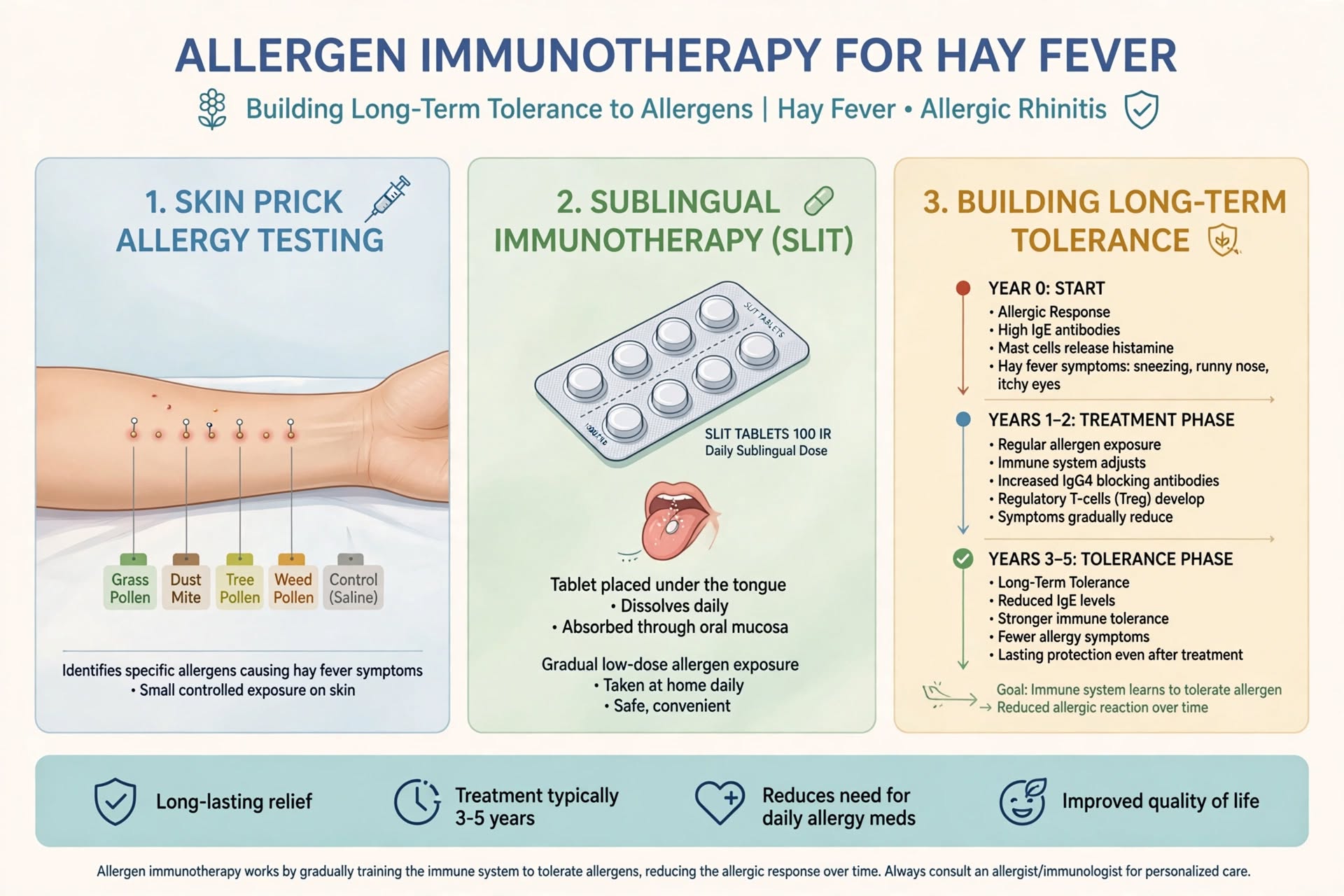
How allergen immunotherapy works, simplified. Suitability and response vary between people, so this needs a specialist assessment.
Hay fever is common, and Perth's spring pollen tends to move from trees to grasses, with the weather nudging symptoms up and down along the way. Most people do best with a plan they stick to: sensible steps to limit pollen exposure and a nasal spray used every day, not just on the worst days.
If symptoms are wearing you down, keep coming back all year, or come with wheeze or chest tightness, that's a good reason to see your GP. This is general health information. Consult your GP.